Three Korean barrier creams keep coming up when Americans ask what Korean dermatology brands actually make: Aestura, Atopalm and Zeroid. All three began as hospital, clinic or “derma” brands. Two of them are made by the same company, and the real differences are in how they deliver ceramides, not in the marketing.
Quick answer
- Aestura Atobarrier365 (Amorepacific): ceramide “capsules.” Easiest to buy in the US (Sephora, $32 for 80 ml).
- Atopalm MLE Cream (Neopharm): a layered “MLE” emulsion with the pseudo-ceramide high on the label. Usually the best value per ml.
- Zeroid Intensive (Neopharm): the clinic-channel sibling of Atopalm, built on the same MLE system, fragrance-free and richer.
- Pick by texture and access, not by “#1” claims. All three are built around the same idea: ceramides plus cholesterol plus fatty acids.
Why these three, and not the usual Amazon picks?
In Korea, “derma cosmetics” is its own shelf. These brands grew up selling through hospitals and dermatology clinics, not as trend launches. Their history tells you a lot about what’s inside.
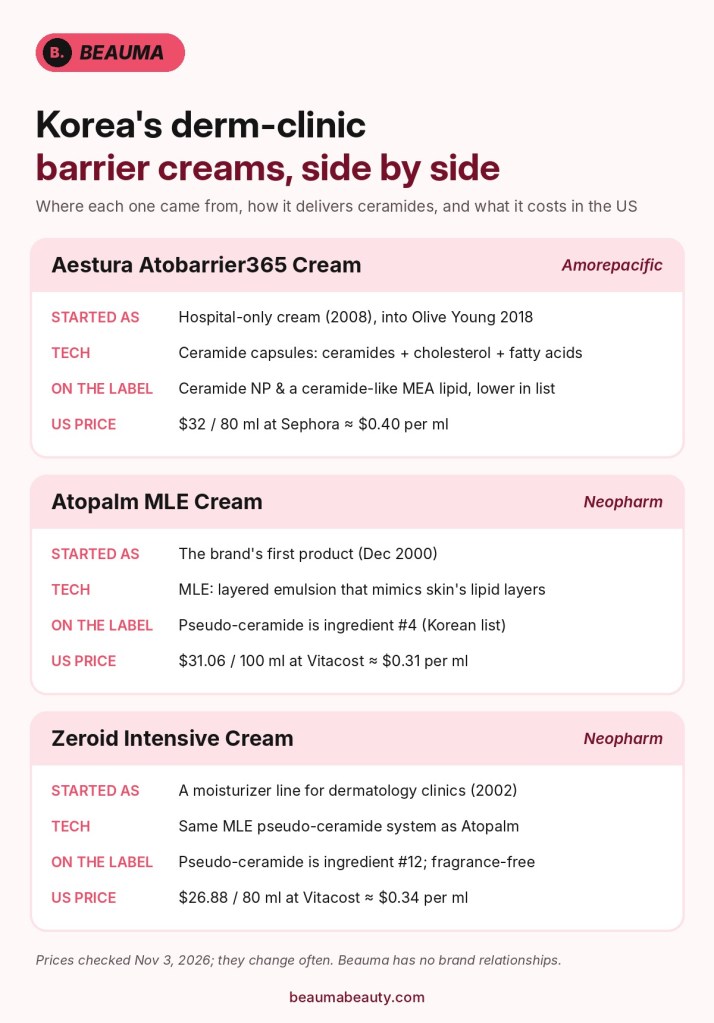
- Aestura traces back to Pacific Pharma (founded 1982). Its Atobarrier cream launched in 2008 as a hospital-exclusive product, entered Olive Young in 2018, and ranked #1 in the Olive Young Awards cream category from 2021 to 2024, according to the brand.
- Atopalm was Neopharm’s very first product, launched in December 2000. In October 2021 it became the first cream approved by Korea’s MFDS as a “functional cosmetic” in the skin-barrier category, the company says.
- Zeroid launched in 2002 as “a moisturizer line for dermatology clinics.” Neopharm still sells it mainly through participating clinics, hospitals and selected retailers.
The detail most English reviews miss: Atopalm and Zeroid come from the same lab and share the same core technology. Zeroid is the version Korean clinics stock; Atopalm is the one you’ll find in regular retail.
MLE vs ceramide capsules: the actual difference
MLE (Atopalm, Zeroid)
MLE stands for Multi-Lamellar Emulsion. Instead of floating lipids in a regular cream base, the emulsion itself is built in stacked layers that imitate the layered lipid structure of your outermost skin. Neopharm says that under a polarizing microscope it shows the same “Maltese-cross” pattern as healthy skin.
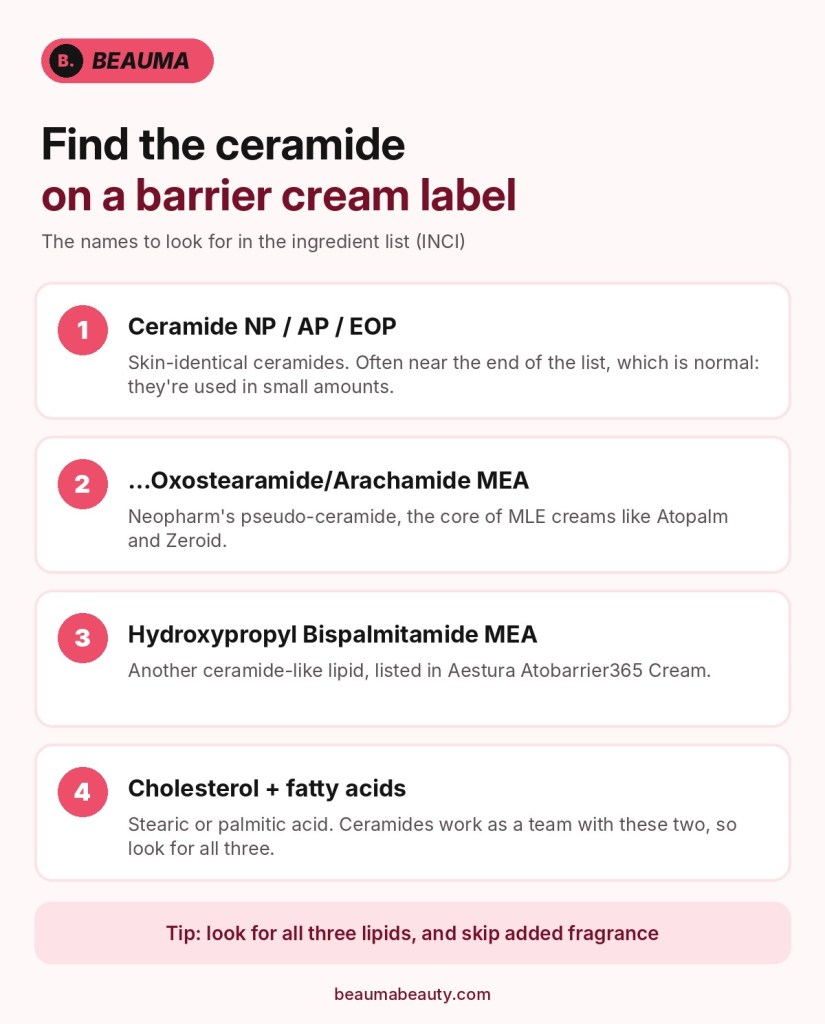
The lipid at its heart is a pseudo-ceramide, a lab-made lipid shaped like a natural ceramide. Neopharm describes a three-part system (“core,” “boost” and “linker” ceramides) blended with cholesterol and fatty acids. On the label, look for Myristoyl/Palmitoyl Oxostearamide/Arachamide MEA.
Ceramide capsules (Aestura)
Amorepacific packs long-chain and “linker” ceramides, cholesterol and fatty acids into tiny capsules that melt when the cream touches skin. The brand claims about one million capsules per jar and, in its own in-vitro test, 190% higher ceramide retention than non-capsule ceramides. That’s a brand claim, not an independent study, but the idea is the same as MLE: deliver the full lipid “team,” not ceramide alone.
A ceramide on its own is a brick with no mortar. Look for the whole team: ceramides, cholesterol and fatty acids.
Read the label like a Korean shopper
Ingredient lists go from most to least. Here’s where the key barrier lipid sits in each cream, based on published ingredient lists:
| Aestura Atobarrier365 | Atopalm MLE Cream | Zeroid Intensive | |
|---|---|---|---|
| Maker | Amorepacific | Neopharm | Neopharm |
| Delivery | Ceramide capsules | MLE | MLE |
| Key lipid on label | Hydroxypropyl Bispalmitamide MEA + Ceramide NP, lower in the list | Pseudo-ceramide at #4 (Korean list) | Pseudo-ceramide at #12 |
| Also notable | Niacinamide, cholesterol | 34 ingredients (Korean list) | Squalane; “free of 10” incl. fragrance |
| Sizes | 80 ml, 45 ml | 65, 100, 160 ml | 80 ml (160 ml in Korea) |
One thing to know: ceramides are used in small amounts, so seeing Ceramide NP near the end is normal. What matters more is whether the formula also has cholesterol and fatty acids, and whether it skips fragrance if your skin is reactive.
A US-shopper heads-up on Atopalm: the “MLE Skin Barrier Cream” sold on Vitacost lists about 60 ingredients and a different order (shea butter, palmitoyl palmitamide MEA) from the 34-ingredient Korean list. We couldn’t find an official statement that these are separate formulas, but the published lists don’t match. Check the box you actually receive.
Korea vs US price
| Cream | Korea (online) | US |
|---|---|---|
| Aestura Atobarrier365 | ₩40,320 sale (~$30) for an 80 ml cream + 120 ml mist set (Kurly) | $32 / 80 ml (Sephora) ≈ $0.40/ml |
| Atopalm MLE Cream | ₩28,500 sale (~$21) for 160 ml + 30 ml (Kurly) ≈ $0.11/ml | $31.06 / 100 ml (Vitacost) ≈ $0.31/ml |
| Zeroid Intensive | ₩54,800 (~$40) / 160 ml (11st) ≈ $0.25/ml | $26.88 / 80 ml (Vitacost) ≈ $0.34/ml, often out of stock |
If you’re visiting Seoul, Atopalm is the clearest bargain: at Korean sale prices it can cost about a third of the US price per ml. Zeroid is a different story. Its clinic version, “Zeroid Intensive Cream MD,” is registered in Korea as a medical device (a type of wound dressing) and is sold through clinics. Across 81 Korean clinics surveyed by the price platform Modoodoc, it averaged ₩41,099 (about $30) for 80 ml, and that price can include clinic fees.
Which one should you pick?
- You want easy access and a light, everyday cream: Aestura. It also carries the National Eczema Association Seal of Acceptance on Sephora US.
- You want value and a pseudo-ceramide high on the label: Atopalm MLE Cream, ideally bought in Korea.
- Your skin is very dry or reactive, and you like richer textures: Zeroid Intensive. Neopharm also makes a separate Zeroid line, Dermanewal, for “skin that feels sensitive after dermatological procedures.”
A simple winter routine with any of the three
- Gentle, low-foam cleanser in lukewarm water.
- A hydrating toner pressed in with your hands while skin is still damp.
- Barrier cream as the last step at night, with a thicker layer on cheeks and around the nose.
- In the morning, a thinner layer under sunscreen.
Fewer steps, one good barrier cream, applied on damp skin: that’s the whole idea behind these derma brands. If you’ve had a laser or skin-booster treatment, see our laser toning aftercare guide and follow your clinic first.
Get our free Seoul Aftercare Cheat Sheet: subscribe below.
FAQ
Is Zeroid the same as Atopalm?
No, but they’re siblings. Both are made by Neopharm and use its MLE pseudo-ceramide system. The formulas, textures and sales channels differ: Zeroid is aimed at dermatology clinics, Atopalm at regular retail.
What does “MLE” mean on a Korean cream?
Multi-Lamellar Emulsion: a cream built in layers that imitate the lipid layers of the skin’s surface. It’s Neopharm’s patented technology.
Is Aestura really “Korea’s #1 dermatologist-recommended” brand?
That’s the brand’s claim. Its press release says it’s based on research Kantar conducted with dermatologists in South Korea in 2023. Sephora’s wording is narrower: “number one derm-recommended brand in Korea for sensitive skin.”
Can I buy Zeroid at Olive Young?
Don’t count on it. Neopharm sells Zeroid mainly through clinics, hospitals and selected retailers. In Korea, online marketplaces such as 11st are the easier route; in the US, check Vitacost and K-beauty retailers.
Why is the ceramide so far down the ingredient list?
Ceramides are used at low levels, so a late spot is normal. Look for cholesterol and fatty acids too, since the three work together.
This article is for general information only and is not medical advice. Prices and formulas change; always check the current label. If you have a skin condition or a recent procedure, follow your dermatologist’s advice. Beauma has no brand relationships with any product mentioned.

Leave a Reply