

Madecassoside is one purified compound from centella asiatica. “Centella asiatica extract” is the whole plant extract, and it can hold a lot of that compound or almost none. That is why two “cica” creams can feel completely different, and why Korean shoppers read the label, not the green packaging.
Quick answer
- Centella’s work is credited to four compounds: madecassoside, asiaticoside, madecassic acid and asiatic acid.
- “Centella Asiatica Extract” on a label tells you the plant is there, not how much of those four.
- Madecassoside listed by name (ideally with a % or ppm) is a stronger signal than a vague “cica complex.”
- TECA (Titrated Extract of Centella Asiatica) is a standardized extract, the format behind Korea’s best-known centella pharmacy ointment.
- If centella sits after the preservatives, it is there for the front of the box.
Madecassoside vs centella extract: what’s the difference?
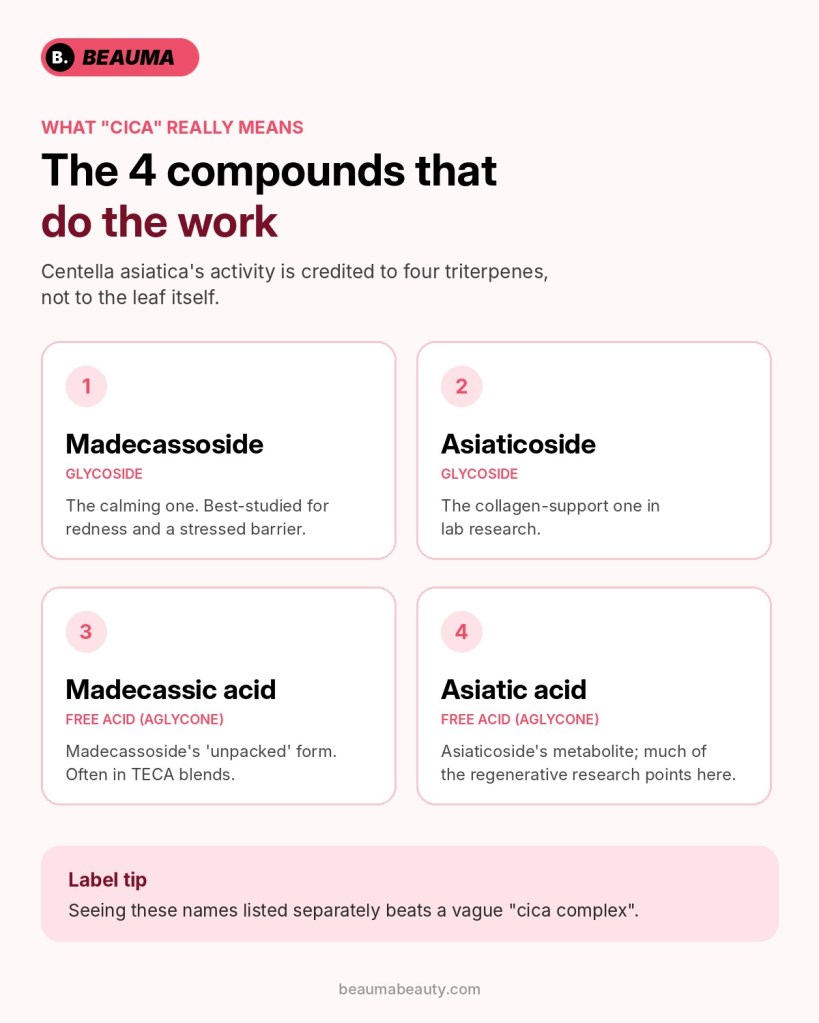
Centella asiatica (gotu kola, called byeongpul in Korean) is a small, round-leafed plant. Research credits its skin activity to four triterpenes: two glycosides, madecassoside and asiaticoside, and their “free acid” forms, madecassic acid and asiatic acid.
When a brand writes “Centella Asiatica Extract,” it means the plant was soaked in water, glycerin or another solvent, and that liquid went into the formula. How much of the four compounds ended up in that liquid depends on the plant, the solvent and the process. The ingredient name stays the same either way.
Madecassoside on a label means the brand added one specific, purified active, not just “some plant.” It is the compound most associated with calming redness and supporting a stressed barrier, which is why it shows up by name in Korean “soothing” lines.
What each of the four is known for
- Madecassoside: leans anti-inflammatory and antioxidant; the “calming” one.
- Asiaticoside: the compound most linked to collagen support in lab studies.
- Asiatic acid: asiaticoside’s metabolite; reviews trace much of the plant’s regenerative activity to it.
- Madecassic acid: the free-acid partner of madecassoside, common in standardized blends.
One honest caveat: much of the deepest mechanism research still comes from lab and animal models. Treat these as what the ingredient is known for, not promises about your face.
The Korean story most US articles skip: TECA
Ask a Korean where “cica” comes from and many will point to a small tube in the family medicine drawer: Madecassol, Dongkook Pharmaceutical’s centella ointment. The name itself comes from Madagascar, the main source of the plant.
- 1970: Dongkook’s predecessor began importing the finished ointment from a French pharmaceutical company.
- 1978: local production started after a manufacturing license in 1977.
- 1984: Dongkook began making the key raw material itself: TECA, a standardized (titrated) extract of centella asiatica.
- 2015: the same company launched its skincare brand, Centellian24, and its Madeca Cream. Korean press reported it passed 68 million units sold by the end of 2024, per the company.
“Titrated” or “standardized” means the extract is processed to a measured level of the active triterpenes, instead of whatever the plant happened to contain. Dongkook’s newer Madecassol Gel, for example, states 2% TECA. That is the kind of number most “cica” creams never give you.
“Cica” on the box is a mood. The four compound names on the back are the information.
How to read a cica label in 30 seconds
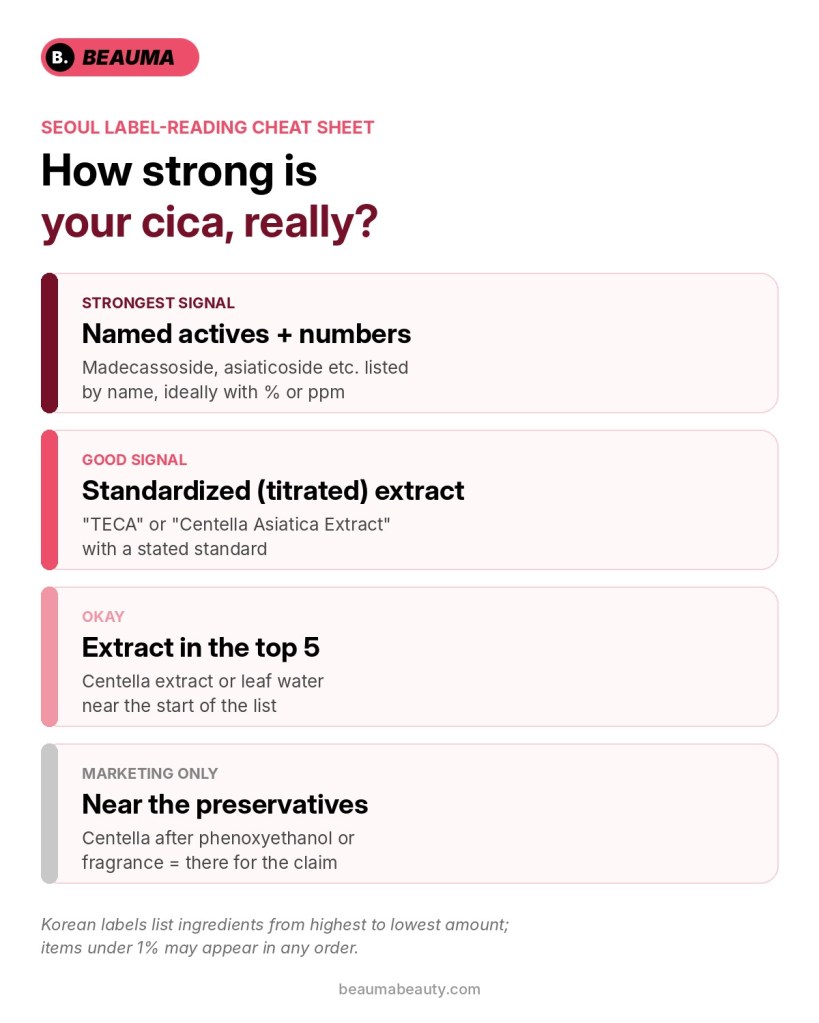
Korean labels, like US ones, list ingredients from highest to lowest amount, but anything at 1% or less can appear in any order. That rule is why position matters only in the top part of the list.
- Look for the four names. Madecassoside, asiaticoside, asiatic acid or madecassic acid listed separately is the best signal.
- Look for a number. Korean brands often print “ppm.” 10,000 ppm = 1%, so “1,000 ppm madecassoside” is 0.1%.
- Check where the extract sits. In the top five is meaningful. After phenoxyethanol, fragrance or other preservatives means a trace.
- Read “100% extract” carefully. It usually means the watery base is centella extract instead of plain water. That is nice, but it is still a percent of extract, not of actives.
- Check for “TECA” or “titrated extract” in the brand’s own description, the standardized format.
A real example of a “transparent” label
Korean brand Derma Factory’s Cica 60.2% Ampoule is a good teaching case. Its ingredient listing on SkinSort shows centella asiatica extract at about 59%, then the four actives broken out: madecassic acid 0.44%, asiaticoside 0.44%, asiatic acid 0.22%, madecassoside 0.1%. You may never buy it, but it shows what a fully transparent cica label looks like. Most products give you only the first line.
Label terms compared
| What the label says | What it actually tells you | Signal strength |
|---|---|---|
| Madecassoside (with % or ppm) | A purified active was added, at a stated level | Strongest |
| The four compounds listed separately | Brand added the actives on purpose | Strong |
| TECA / titrated extract | Standardized level of triterpenes | Strong |
| Centella Asiatica Extract, top 5 | Plenty of extract; active content unknown | Medium |
| Centella Asiatica Leaf Water | A watery base made from the leaf; usually mild | Low to medium |
| “Cica complex” or centella near the end | Mostly there for the claim | Low |
Which one should you look for?
- Red, reactive or “everything stings” skin: look for madecassoside by name, in a simple formula with few extras.
- Dry, tight, flaky skin: centella works best in a cream or balm with ceramides and panthenol, which is how Korean “barrier” creams pair it.
- Oily skin that wants calm without heaviness: a high-extract ampoule or toner is the lighter way in.
- Just want the classic: a standardized (TECA-type) formula is the Korean pharmacy-heritage route.
How Koreans layer it: a centella toner or ampoule first, then a cica cream or balm on top, and a balm stick on dry spots during the day. If you only buy one, buy the leave-on cream, not the wash-off cleanser. A cleanser rinses away before the actives can do much.
FAQ
Is madecassoside better than centella asiatica extract?
Not automatically. Madecassoside is more specific and easier to measure. A good extract contains madecassoside plus the other three compounds. The best labels give you both: the extract and the named actives.
Is “cica” the same as centella?
Yes, “cica” is marketing shorthand for centella asiatica. It is not an ingredient name, so you will never see it in a proper ingredient list.
What does “ppm” mean on Korean cica products?
Parts per million. 10,000 ppm equals 1%. Large ppm numbers look impressive on the box, so convert them before you compare.
What is TECA in skincare?
Titrated Extract of Centella Asiatica: an extract standardized to a measured level of centella’s active triterpenes. In Korea it is closely tied to Dongkook Pharmaceutical, which has made it in-house since 1984.
Can I use centella with retinol or vitamin C?
Centella is generally considered a gentle, easy-to-pair ingredient, and US cosmetic safety reviewers have found it safe at current cosmetic concentrations. Many Koreans use a cica cream as the calming layer on nights they use stronger actives. Patch-test anything new.
This article is for general information only and is not medical advice. Beauma Beauty has no brand relationships with any product mentioned. Company figures are as reported in Korean press; ingredient percentages are from public product listings. Patch-test new products, and see a dermatologist for skin concerns.

Leave a Reply