Short answer: it depends on the type of scaler you bought, and Korean labels don’t agree with each other. Most Korean scalp scalers go on before shampoo, but one popular type goes on a dry scalp before you even step in the shower, and another goes on after shampoo. Here’s how to tell which one you have, and how Koreans actually fit it into a wash day.
Quick answer
- Liquid or gel scaler: wet scalp, massage, rinse, then shampoo.
- Foaming pre-wash scaler: dry scalp, leave 2–3 minutes, add water, rinse.
- Serum-scrub tubes or ampoules: after shampoo, massage 1–2 minutes, rinse.
- Most Korean labels say 1–3 times a week, not daily.
- Use one scaler per wash. Never stack two.
What a scalp scaler actually is
A scalp scaler is an exfoliating step for the skin on your head. In an October 2026 report on the trend, the UK trade magazine Cosmetics Business described it as a liquid or gel exfoliant used before shampooing to lift sebum, styling buildup, pollution particles and dead skin, and noted the products are usually salt-, AHA/BHA- or enzyme-based.
In Korea it’s the at-home version of the head spa you see in Seoul salons: cleanse the scalp properly first, then wash the hair. The cooling tingle most people notice comes from menthol and mint oils, which show up in almost every Korean scaler. That tingle feels nice, but it isn’t a sign the product is “working.”
Before or after shampoo? The 3 types
This is where Google answers get confusing, because product labels really do disagree. We read the directions on three widely sold Korean scalers, and each one says something different:
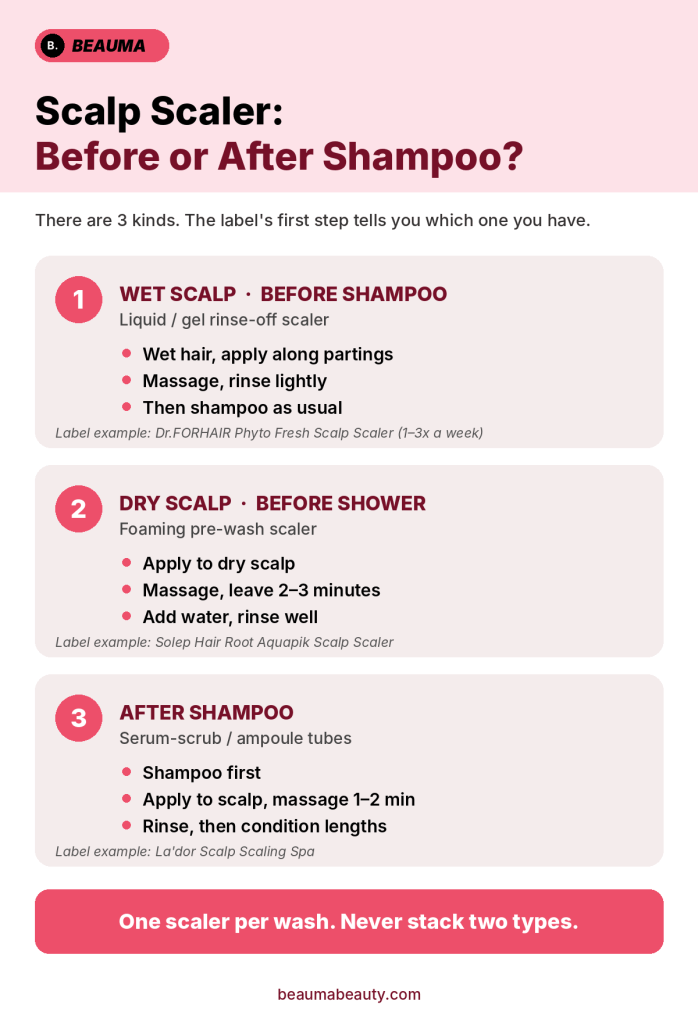
1. Liquid or gel scaler: wet scalp, before shampoo
This is the classic type. Dr.FORHAIR Phyto Fresh Scalp Scaler (200 ml) tells you to apply it to a wet scalp, massage well, rinse lightly with lukewarm water, and then shampoo, 1–3 times a week depending on your scalp. Retailers list salicylic acid, peppermint and mint oil, green tea and tea tree as its key ingredients.
2. Foaming pre-wash: dry scalp, before the shower
Some newer scalers are made for a dry scalp. Solep Hair Root Aquapik Scalp Scaler (250 ml) says to apply it all over a dry scalp before showering, massage, leave it 2–3 minutes, then add water so it foams and rinse. Its listed actives are AHA, PHA and BHA with hinoki (Japanese cypress) water.
3. Serum-scrub tubes: after shampoo
Single-use tubes work the other way around. La’dor Scalp Scaling Spa comes as a box of 15 g tubes, and its directions say to apply it after shampooing, massage with your fingertips for 1–2 minutes, then rinse. Its ingredient list includes salicylic acid, mint oil, niacinamide, green tea and hinokitiol.
The first step on the label tells you everything. Read the verb before you read the ingredients.
| Type | Scalp | When | Time on scalp | Example |
|---|---|---|---|---|
| Liquid / gel rinse-off | Wet | Before shampoo | Massage, then rinse | Dr.FORHAIR Phyto Fresh |
| Foaming pre-wash | Dry | Before shower | 2–3 min | Solep Aquapik |
| Serum-scrub tube | Wet, washed | After shampoo | 1–2 min massage | La’dor Scalp Scaling Spa |
| Salt or sugar scrub | Wet | Check the label | Gentle massage only | Kundal Sea Salt, Aromatica Rosemary |
How Koreans fit a scaler into wash day
In Seoul, scalp care is treated like skincare, in steps. A typical scaler day using the most common (before-shampoo) type looks like this:
- Brush first. Detangle dry hair so you can part it easily.
- Apply along partings. Section the hair and put the scaler on the skin, not the lengths.
- Massage with fingertips, not nails. Small circles from the hairline back toward the crown.
- Rinse, then shampoo. One wash is usually enough after a scaler.
- Conditioner on the lengths only. Keep it off the freshly cleaned scalp.
- Scalp tonic or serum last. On a towel-dried scalp, before blow-drying.
That last step matters more in Korea than in the US. Olive Young has a whole scalp ampoule and tonic category with its own weekly top-100 ranking. Koreans see the scaler as the “cleanse” step and the tonic as the “care” step, in the same way they’d follow a face wash with a serum.
What’s actually on the Olive Young “scaler” shelf right now
Here’s something US shoppers rarely hear. On Glowpick’s ranking for Olive Young’s hair scaler category (updated November 2, 2026), the top two spots aren’t scalers at all. They’re hair vinegars, acidic rinses used after shampoo. Three of the top eight are hair vinegars, and one is a scalp pack.
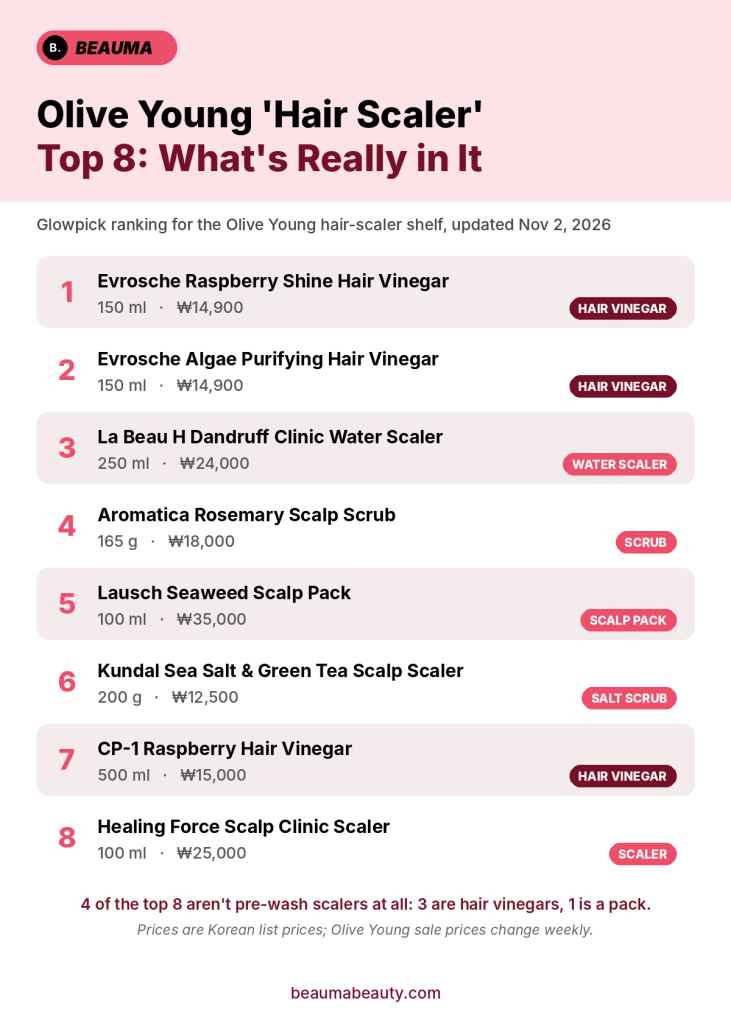
So if you’re shopping in Seoul and pick up the #1 “scaler,” check the label. A hair vinegar is a finishing rinse, not a pre-wash exfoliant. Most of the true scalers on that list cost ₩12,500–₩25,000 at Korean list price, before Olive Young’s frequent sales.
Korean labels vs US labels: the salicylic acid gap
Many Korean scalers list salicylic acid, but as a cosmetic they don’t usually print how much. In the US, a product that claims to control dandruff with salicylic acid is regulated as an over-the-counter drug, and the FDA monograph (21 CFR 358.710) allows 1.8–3% for that use, with a “Drug Facts” box on the label.
That’s why the same kind of product can look very different on Amazon US and on an Olive Young shelf. A Korean scaler with no percentage isn’t necessarily weak, and a US scalp treatment with a Drug Facts box isn’t automatically better. They’re simply sold under different rules. If your flaking is persistent, itchy or red, a dermatologist is a better first stop than any scaler.
5 mistakes that make a scaler feel harsh
- Using two types in one wash. A pre-wash scaler plus an after-shampoo tube doubles the acids and menthol.
- Leaving it on longer than the label says. “2–3 minutes” doesn’t mean 10.
- Scrubbing with nails. Fingertip pads only, especially with salt scrubs.
- Using it every day when the label says 1–3 times a week.
- Applying it on a scalp that’s already sore, scratched or sunburned. Skip it until the skin is calm.
FAQ
Can I use a scalp scaler every day?
Most Korean scalers we checked say 1–3 times a week. A few gentle formulas allow daily use, so go by your own label. If your scalp feels tight or stingy, cut back.
Does a scalp scaler replace shampoo?
Usually not. Before-shampoo and dry-scalp types are designed to be followed by a wash, and the after-shampoo tubes assume you’ve already shampooed.
Is a scalp scaler the same as a scalp scrub?
Not quite. Scrubs use salt or other grains to buff physically. Liquid scalers mostly rely on acids or enzymes. Olive Young files both on the same shelf, which adds to the confusion.
What is Korean hair vinegar?
It’s an acidic rinse used after shampoo, popular enough in Korea to top Olive Young’s scaler ranking. Think of it as a finishing step, not an exfoliant.
Do I need a scalp serum after a scaler?
You don’t have to, but that’s the Korean habit: cleanse the scalp with a scaler, then apply a light tonic or serum to the towel-dried scalp.
This article is general information, not medical advice. Directions and prices come from brand and retailer listings and Glowpick’s Olive Young ranking as of November 2026, and may change. Beauma has no brand relationships with any product mentioned. Patch-test new scalp products, and see a dermatologist for persistent scalp concerns.

Leave a Reply