
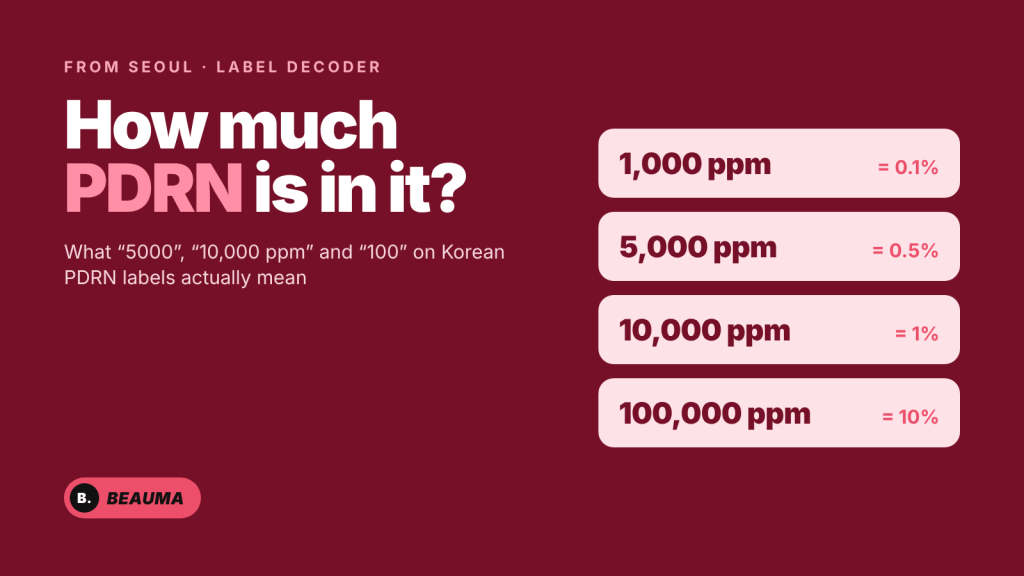
Every PDRN bottle on the Olive Young shelf seems to shout a number: 5000, 10,000 ppm, 100. So how much PDRN is actually in your skincare? Short answer: 10,000 ppm is 1%, and the number on the front only tells half the story. The other half is printed in small type on the back, and Korean labels follow a rule that most English guides never mention.
Quick answer
- ppm to percent: 1,000 ppm = 0.1%, 5,000 ppm = 0.5%, 10,000 ppm = 1%, 100,000 ppm = 10%.
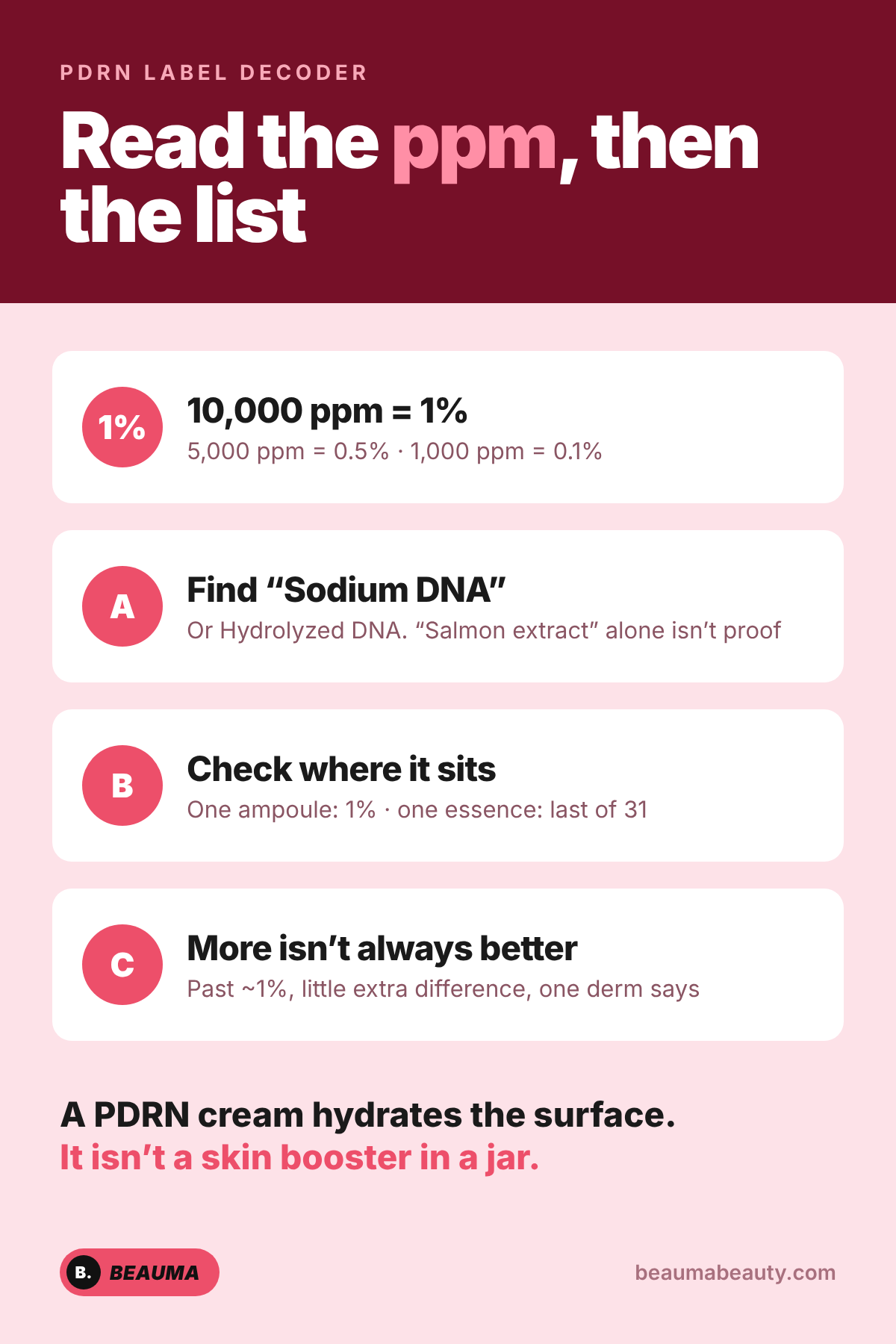
- On the label, PDRN isn’t called PDRN. Look for Sodium DNA or Hydrolyzed DNA. “Salmon extract” alone doesn’t prove there’s PDRN inside.
- The front number can describe the raw material, not the finished product. One essence marketed with 100,000 ppm lists Sodium DNA last of 31 ingredients.
- More isn’t automatically better. One dermatologist quoted in Singapore’s Peak magazine says going past about 1% made only a nominal difference.
- Topical PDRN hydrates and smooths the surface. It isn’t a substitute for an in-clinic PN or PDRN booster.
What ppm means on a PDRN label
ppm means “parts per million.” It’s a way to write very small amounts without long decimals. The conversion is simple: divide ppm by 10,000 to get a percentage. Dr Chester Lan, quoted in Singapore’s The Peak, puts it the same way: a serum with 0.1% PDRN holds about 1,000 ppm, and one with 1% holds 10,000 ppm.
Why do Korean brands prefer ppm? Because “10,000” looks a lot more impressive on a box than “1%.” That’s not dishonest on its own, but it’s worth translating in your head every time you shop.
| Number on the box | As a percentage | How to think about it |
|---|---|---|
| 1,000 ppm | 0.1% | A small, supporting amount |
| 5,000 ppm | 0.5% | Mid-range for a cosmetic |
| 10,000 ppm | 1% | The level most “high PDRN” products aim for |
| 100,000 ppm | 10% | Almost always refers to a raw-material solution, not pure PDRN (see below) |
How to find PDRN on a Korean ingredient list
Here’s the first thing that trips people up: you won’t find the word “PDRN” in the official ingredient list (전성분, jeonseongbun). Korean clinic-review app Gangnam Unni explains that cosmetics list it as Sodium DNA (소듐 DNA) or Hydrolyzed DNA (하이드롤라이즈드 DNA). It also warns that a product saying only “salmon extract” or “salmon DNA” on the front doesn’t confirm PDRN is in the formula. Turn the box over and check.
The 1% rule nobody tells you about
Ingredient lists in Korea (and the EU) run from most to least, but with one big exception: ingredients used at 1% or less can be listed in any order. That matters a lot for PDRN, because almost every PDRN product sits at or below 1%.
So the position of Sodium DNA tells you two things, and only two:
- If it appears above the preservatives and thickeners (think phenoxyethanol, 1,2-hexanediol, carbomer), the brand is likely using a real amount.
- If it’s the very last item, you can’t tell much from position alone. It could still be 1%, or it could be a trace. That’s when the brand’s own ppm claim and what it refers to matter most.
The Peak’s article makes a similar point from the other side: if “DNA” shows up very low on the list, chances are the concentration is too low to matter, and many brands simply don’t disclose the number at all.
PDRN products compared: the number vs the label
We lined up six PDRN products you’ll see in Seoul and on US K-beauty shops, and compared what the front says with what the label and retailers actually show. Where a brand or editor gave no number, we say so rather than guess.
| Product | PDRN amount stated | What the label shows | Price seen |
|---|---|---|---|
| Medicube PDRN Pink Peptide Ampoule, 30 ml | 1% (about 10,000 ppm), per Allure Korea | No full list checked for this post | ₩29,000 (about $20) |
| Dr.Althea PDRN Reju 10000 Cream, 20 g | 10,000 ppm (1%), per StyleKorean listing | List not shown on that page | $24.40 on sale, $34.90 list (StyleKorean) |
| Dr.Althea PDRN Reju 5000 Cream, 20 g | “5000” in the name, which would be 0.5% if it means ppm | Sodium DNA 14th of 34 ingredients | €19.02 (Shop Apotheke, Germany) |
| VT PDRN Essence 100, 30 ml | 100,000 ppm of ginseng-derived “Phyto PDRN,” per a retailer listing | Sodium DNA last of 31 ingredients | $26–28 (Walmart, Ulta, Soko Glam via Skincarisma) |
| Rejuran Dermahealer Moisture Treatment Ampoule, 30 ml | “High content” c-PDRN, no figure given | No full list checked for this post | ₩45,000 (about $32) |
| Anua PDRN Hyaluronic Acid Capsule 100 Serum, 30 ml | Not disclosed; Allure Korea notes its PDRN content is “not high” | No full list checked for this post | ₩39,000 (about $28) |
The VT puzzle: 100,000 ppm, listed last
This is the one that confuses shoppers most. A retailer listing describes VT’s essence as made with 100,000 ppm of plant-derived PDRN. That would be 10%, ten times the 1% Medicube ampoule. Yet on the full ingredient list, Sodium DNA comes 31st out of 31.
VT doesn’t explain the gap, so here’s our reading, not the brand’s: a very large ppm figure like this almost certainly describes the PDRN raw-material solution that goes into the bottle (an extract or solution containing DNA), not pure Sodium DNA in the finished essence. The list position, after a long run of other ingredients, fits a small final amount. That doesn’t make it a bad product. It means the “100” isn’t a strength comparison you can line up against a “10,000 ppm” cream.
The number on the front is marketing. The ingredient list on the back is where you check it.
Free: The Seoul Aftercare Cheat Sheet
Buying PDRN because you just had Rejuran or a skin booster? Our one-page cheat sheet shows what Korean clinics tell you to use, and what to skip, after boosters, Rejuran, laser toning, HIFU and Botox. Leave your email and we’ll send it straight over, plus new label decoders like this one from Seoul.
Does a higher PDRN concentration mean better results?
Not in a straight line. In the same Peak article, Dr Lan says pushing beyond 1% made only a nominal difference, and Dr Michelle Wong notes that over-the-counter PDRN products often contain far less than what’s used in controlled clinical studies, most of which look at in-clinic injectables like Rejuran or Plinest.
There’s also a texture trade-off that Korean editors talk about more than US ones. Allure Korea notes that higher-content PDRN serums turn thicker, with a slightly oily, filmy feel. Anua’s marketing manager told the magazine the brand’s tip is to apply a thin layer several times rather than one heavy layer.
Cream vs injection: what PDRN skincare can and can’t do
Gangnam Unni puts it plainly: injected PDRN reaches the dermis, while cosmetic PDRN stays in the outermost layer of skin because of its particle size. What it can do there is hydrate, soften texture and support a comfortable barrier. What it can’t do is replicate a booster. Rejuran-style PN, the app adds, uses larger particles and is only delivered by injection.
If you’re shopping because you just had a treatment, our skin booster aftercare guide and Rejuran aftercare guide cover when a PDRN cream fits in, which is usually after the first few days, not on day 0.
Which PDRN product should you buy?
- You want a disclosed number: pick a product that names its PDRN amount, like the 1% Medicube ampoule or Dr.Althea’s 10,000 ppm cream, and then confirm Sodium DNA on the list.
- You mainly want a glowy, hydrating step: a lower-PDRN serum like Anua’s or VT’s essence is fine. Judge it on texture and the rest of the formula, not on the PDRN number.
- Your skin is sensitive or post-treatment: keep it simple. A short ingredient list with no added fragrance matters more than ppm. Our cica label guide uses the same label-reading logic.
- You’re buying in Seoul: check for Olive Young’s 1+1 or bundle deals. Compare the Korean price with US retail before you stock up; the gap varies a lot by product.
PDRN concentration FAQ
Is 10,000 ppm PDRN a lot?
It’s 1%. For a cosmetic that’s on the higher end, and one dermatologist quoted in The Peak says going beyond that made little extra difference. It’s still far from what an injection delivers to the skin.
What does the “5000” or “100” in a PDRN product name mean?
Usually a ppm figure, but brands don’t always say what it refers to. A number can describe the finished product or the raw material that went into it. If the brand doesn’t specify, use the ingredient list as your reality check.
Is plant PDRN the same as salmon PDRN?
Both are marketed as PDRN, and both can appear as Sodium DNA on the label. The source differs: salmon DNA is the classic one, while products like VT’s describe a ginseng-derived “Phyto PDRN.” Brands don’t publish head-to-head comparisons, so treat them as different ingredients that share a name.
Can I use PDRN skincare right after a skin booster?
Most aftercare guides we’ve read keep the first days plain: gentle cleanser, a soothing layer, barrier cream and sunscreen. Bring a PDRN product in once redness and stinging are gone, and follow your clinic’s instructions first.
Get the Seoul Aftercare Cheat Sheet
One page, every major Korean treatment: what to use, what to skip, and for how long. Free when you join the Beauma list. Written from Seoul; we only send what we’d want to read ourselves.
This post isn’t sponsored, and Beauma Beauty has no relationship with any brand mentioned. Sources: The Peak (Singapore), “PDRN skincare explained,” Oct 2025; Gangnam Unni, “PDRN이란?” (2026); Allure Korea, “PDRN 세럼,” Feb 2025; retailer listings at StyleKorean, Shop Apotheke, K Beauty World and Skincarisma. Our reading of the VT ppm figure is an interpretation, not a brand statement. General information, not medical advice. Prices are approximate and change often.

Leave a Reply